
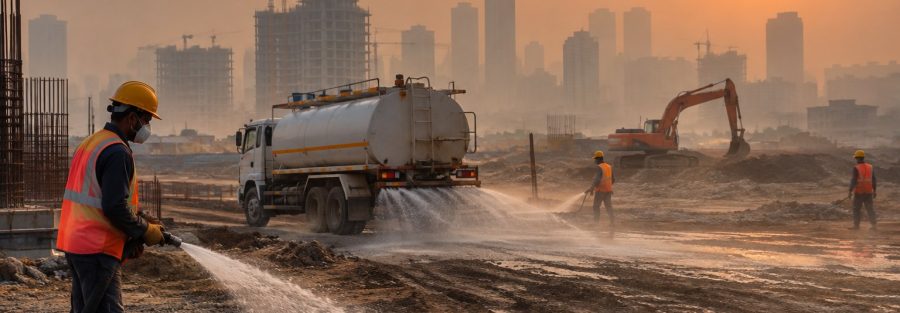
The Commission for Air Quality Management (CAQM) activated Stage I of the Graded Response Action Plan across Delhi-NCR on 21 October 2026 after the region’s air quality entered the “Poor” category.
GRAP is not limited to government agencies. Construction projects, factories, warehouses, commercial establishments, hotels, restaurants, fleet operators and facility-management teams may all have operational responsibilities. Since GRAP stages can be activated, escalated or withdrawn according to air quality, every organisation should record the stage and date against which compliance was reviewed.
What does GRAP Stage I require?
Stage I focuses on controlling construction dust, vehicle emissions, industrial pollution, waste burning and emissions from diesel-generator sets.
1. Construction and demolition dust
- Provide effective dust-control and suppression measures.
- Cover loose construction material and C&D waste.
- Transport debris and dusty material only in covered vehicles.
- Use water sprinkling, wheel-washing and access-road cleaning as applicable.
- Operate anti-smog guns wherever required.
- Maintain photographs and daily records of dust-control activities.
Construction projects measuring 500 square metres or more should verify applicable Delhi-NCR portal registration and remote-monitoring requirements.
2. Diesel-generator sets
Maintain a DG register covering capacity, fuel, emission-control system, dual-fuel conversion or retrofit status, maintenance history, operating purpose and duration. DG sets should not be used as routine power where GRAP restrictions prohibit it; permitted or emergency use should be documented.
3. Industrial emissions
- Verify consent conditions and approved fuels.
- Review stack-emission and monitoring records.
- Check air-pollution-control equipment and preventive maintenance.
- Control fugitive emissions and dusty material storage.
- Retain evidence required for online or remote monitoring.
4. Waste and open burning
Prevent burning of leaves, packaging and other waste; illegal dumping; delayed waste removal; and accumulation of combustible waste. A daily housekeeping and waste-lifting record provides useful evidence.
5. Hotels, restaurants and kitchens
Hotels, restaurants and open eateries should verify compliance with restrictions on coal or firewood in tandoors and use approved electricity, gas or other clean fuels.
6. Vehicles and transport
Check valid pollution-under-control certificates, vehicle maintenance, covered transport of dusty material, visible emissions, unnecessary idling and contractor compliance.
Documents to keep ready
- Applicable GRAP order and activation date
- Site-specific checklist and action tracker
- C&D portal registration, where applicable
- DG inventory and emission-control evidence
- Fuel, PUC and vehicle records
- Waste-disposal and dust-control logs
- Photographic compliance evidence
How Safety Zest can help
Safety Zest provides GRAP compliance-readiness assessments for construction sites, factories, warehouses, commercial facilities and hospitality establishments. The review can include onsite inspection, DG and fuel verification, dust and waste controls, contractor compliance, evidence-register preparation and a management action dashboard.
The assessment does not replace portal registration, regulator submissions, consent amendments or laboratory emission testing unless expressly included.
Need a GRAP compliance-readiness audit?
Visit www.safetyzest.com, call +91-9538541881 or email info@safetyzest.com.
Safety First Always.
Reference
Commission for Air Quality Management — official GRAP orders and updates