
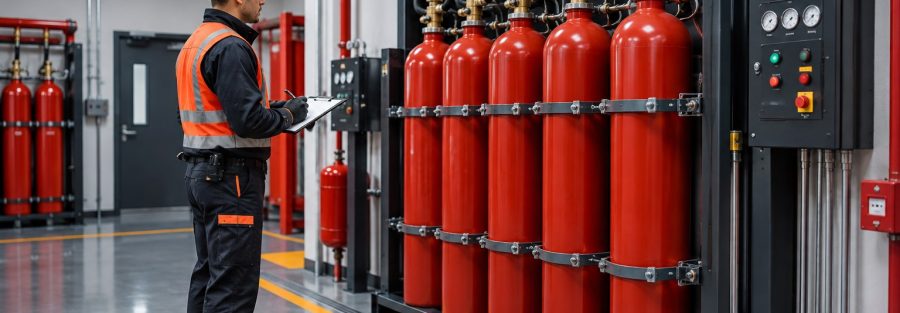
Fixed gaseous fire-suppression systems protect critical equipment and high-risk areas. Their maintenance, however, can expose workers to accidental discharge, oxygen displacement, stored energy and fatal asphyxiation.
A June 2026 CO₂ leak during fire-system maintenance at an industrial plant in Maharashtra killed two workers. Later enforcement action involving contractor and company personnel, including senior management, shows why fire-system maintenance must be treated as a high-risk controlled activity rather than routine vendor servicing.
Why is CO₂ dangerous?
Carbon dioxide is colourless and can accumulate without adequate warning. In enclosed or low-lying spaces, a release can displace breathable oxygen. A person may become disoriented or unconscious before recognising the danger, while an unprotected rescue attempt can create additional casualties.
Pre-maintenance requirements
- Approved method statement, risk assessment and permit to work
- Identification of every cylinder, actuator and discharge zone
- Review of system drawings and cause-and-effect logic
- Verification of authorised and competent technicians
- Isolation and lockout of automatic and manual release paths
- Safe restraint of cylinders before disconnection
- Barricading and evacuation of the protected area
- Communication with security, fire and operations teams
- Defined emergency and rescue arrangements
Placing a fire-alarm panel in manual mode may not isolate every mechanical, pneumatic or electrical release path. The isolation plan must cover the complete system.
Cylinder-handling controls
- Secure cylinders against falling or uncontrolled movement.
- Fit valve-protection devices before transport.
- Do not handle cylinders by valves or connected piping.
- Use appropriate trolleys and lifting equipment.
- Verify cylinder condition, pressure and identification.
- Store disconnected cylinders in an approved, ventilated area.
- Control subcontracting and verify each worker’s competence.
Ventilation and atmospheric monitoring
Maintenance in basements, pits and enclosed rooms needs additional controls. Assess where CO₂ could collect, provide mechanical ventilation where needed, test oxygen before entry and use continuous monitoring for higher-risk work. Prevent re-entry after an unplanned discharge until atmospheric testing confirms safe conditions.
Emergency preparedness
- Immediate evacuation and personnel accounting
- Prevention of unprotected rescue attempts
- Source isolation only when safe
- Trained standby rescuers
- Self-contained breathing apparatus for designated responders
- First aid and emergency medical support
- Post-release atmospheric testing and investigation
Ordinary masks and cartridge respirators do not provide breathable air in an oxygen-deficient atmosphere.
Reinstatement and handover
After maintenance, verify cylinder connections and restraints, restore actuators in a controlled sequence, test alarms and interlocks, remove temporary bypasses, update service records and obtain a written contractor handover before declaring the system operational.
How Safety Zest can help
Safety Zest’s Fixed Gaseous Fire-Suppression Maintenance Safety Review covers permit controls, isolation, contractor competence, cylinder handling, ventilation, atmospheric monitoring, emergency readiness, impairment management and reinstatement documentation.
The review does not include cylinder hydrotesting, refilling, discharge testing, OEM certification or statutory certification unless separately arranged through an eligible specialist.
Arrange a fire-suppression maintenance safety review:
Visit www.safetyzest.com, call +91-9538541881 or email info@safetyzest.com.
Safety First Always.
Further reading
Reported enforcement development following the Maharashtra CO₂ incident